
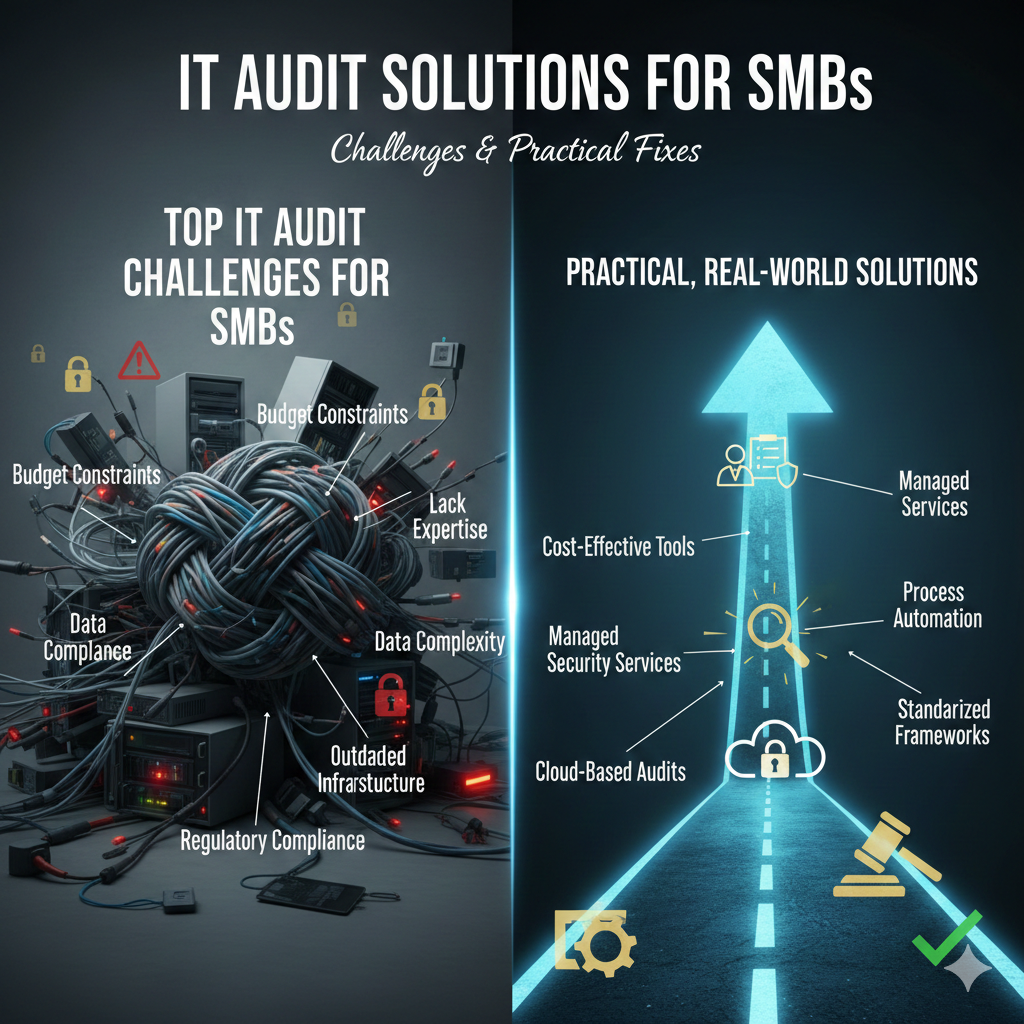
The Constraint of Limited Budget and Sparse In-House Resources
Challenge: The vast majority of SMBs lack a dedicated internal compliance or security team, forcing already-overburdened IT personnel who are primarily focused on maintaining daily operational stability and supporting business functions to juggle the extensive, detail-oriented tasks of audit preparation, evidence collection, and control implementation alongside their routine responsibilities, leading to potential burnout and oversight.
Solutions:
- Strategically deploy affordable, cloud-native, and automated compliance tools such as streamlined GRC platforms specifically engineered for SMBs to reduce manual effort and ensure consistent control monitoring.
- Engage fractional or virtual Chief Information Security Officer (vCISO) services to procure expert, strategic guidance and leadership without incurring the prohibitive cost of a full-time executive, thereby bridging the expertise gap.
- Rigorously prioritize initiatives based on a formalized risk assessment, concentrating initial efforts and capital on high-impact, high-risk areas such as customer data protection, privileged access management, and secure software development to maximize return on security investment.
2. The Prevalent Issue of Poor or Incomplete Documentation
Challenge: Missing, outdated, or inconsistent policies, procedures, and records of activity constitute one of the most frequent and damaging audit findings across SMBs, as auditors rely on documentary evidence to verify the existence and operating effectiveness of stated controls, and gaps here can directly lead to audit failures and costly remediation mandates.
Solutions:
- Systematically standardize internal documentation by leveraging and customizing established policy and procedure templates for information security, access control, and incident response to ensure comprehensive coverage and professional presentation.
- Adopt and maintain a centralized, accessible documentation management system—such as a configured wiki, SharePoint instance, or dedicated GRC module—to serve as a single source of truth for all compliance artifacts.
- Institutionalize a schedule of quarterly or semi-annual formal documentation reviews and updates, assigning clear ownership to ensure that all materials accurately reflect current processes, technologies, and organizational structures.
3. The Critical Weakness in Third-Party and Supply Chain Risk Management
Challenge: Technology SMBs exhibit a high degree of operational dependency on a myriad of vendors—including cloud infrastructure providers, SaaS platforms, and development toolchains—yet formalized vendor vetting processes are often minimal or entirely absent, creating substantial unmanaged supply chain risks that can compromise the entire organization’s security.
Solutions:
- Develop and systematically apply a standardized vendor risk assessment checklist that evaluates potential partners based on security practices, data handling, and compliance certifications before contract signing.
- Categorize all vendors into tiered risk levels (e.g., high, medium, low) based on their access to sensitive data or critical systems, and apply corresponding levels of due diligence and ongoing monitoring.
- Proactively request and review independent audit reports, such as SOC 2 Type II or ISO 27001 certifications, from all critical and high-risk vendors as a prerequisite for engagement, ensuring their controls meet your required standards.
4. The Persistent Problem of Inadequate Identity and Access Controls
Challenge: Audits consistently uncover excessive user permissions, the use of shared generic accounts, a lack of clear role definitions, and infrequent access reviews, which collectively violate the principle of least privilege and dramatically increase the risk of insider threat or credential compromise leading to significant data breaches.
Solutions:
- Formally implement a Role-Based Access Control (RBAC) model across all critical systems and applications, defining roles based on job functions and granting only the permissions absolutely necessary to perform those functions.
- Perform and document quarterly access rights reviews and certifications for all systems handling sensitive data, ensuring access is promptly revoked upon role changes or termination.
- Apply the “least privilege” principle universally by configuring system defaults to deny access and requiring explicit justification for any permission elevation, complemented by implementing just-in-time access where feasible.
5. The Dangerous Gap in Formal Incident Response Planning and Preparedness
Challenge: A significant number of SMBs operate without a structured, documented, and tested incident response program, meaning that when a security breach or IT disruption occurs, the response is reactive, chaotic, and slow, leading to extended downtime, greater data loss, regulatory penalties, and reputational damage.
Solutions:
- Build a simple, actionable, and clearly documented Incident Response (IR) Plan that outlines specific steps for identification, containment, eradication, recovery, and lessons learned, with assigned roles and communication protocols.
- Conduct tabletop IR exercises at least twice annually, simulating realistic breach scenarios to validate the plan, train the response team, and identify procedural weaknesses in a low-stakes environment.
- Establish and socialize clear internal and external communication workflows, including templates for notifications, to ensure a coordinated, compliant, and timely response to stakeholders, customers, and, if required, regulatory bodies.
The Comprehensive SMB IT Audit Readiness Checklist: A Foundation for Success
Utilize this detailed, actionable checklist as a systematic framework to methodically prepare for and successfully navigate your next IT compliance audit.
Foundational Documentation Essentials
- A formally approved and communicated Information Security Policy
- An Acceptable Use Policy (AUP) for IT resources
- A practical and tested Incident Response Plan
- A viable Business Continuity and Disaster Recovery (BC/DR) Plan
- A Data Classification and Handling Policy
- A Vendor Management and Risk Assessment Policy
- A detailed Access Control and Identity Management Policy
- Documented Change Management Procedures for systems and networks
Mandatory Technical Security Controls
- Multi-Factor Authentication (MFA) enforced for all administrative and privileged user accounts
- Regular, automated vulnerability scans of networks and applications, with a defined remediation process
- Next-generation endpoint protection deployed on all company-owned and BYOD devices accessing corporate data
- Quarterly-tested, encrypted, and off-site backups of critical data and systems
- Centralized log management with a minimum 90-day retention policy for all security-relevant events
- Basic network segmentation to isolate sensitive systems (e.g., databases, development environments) from general corporate networks
- A Mobile Device Management (MDM) solution to enforce security policies on smartphones and tablets
Essential Governance, Process, and People Controls
- Annual, role-specific security awareness and phishing training for all employees
- Formal background verification checks for personnel in sensitive roles (e.g., system administrators, developers with production access)
- Quarterly access reviews and certifications documented for auditing purposes
- An annual, documented IT risk assessment that informs the security strategy
- Signed employee acknowledgements of key security and acceptable use policies
- A clearly defined and trained incident response team with designated leads for technical, communication, and legal functions
Expert Strategies for IT, Audit, Risk & Compliance Professionals Operating within SMBs
- Initiate your program with an Established Framework: Adopt and adapt the NIST Cybersecurity Framework (CSF) or the CIS Critical Security Controls to provide a structured, industry-recognized foundation for your security program without the need to reinvent foundational principles.
- Aggressively Leverage Cost-Effective Technology: Implement cloud-based Governance, Risk, and Compliance (GRC) tools to dramatically simplify the continuous tasks of control tracking, automated evidence gathering, and audit reporting, thereby increasing efficiency and accuracy.
- Articulate Security in Terms of Business Objectives: Systematically translate technical risks into clear financial, operational, and reputational terms when communicating with executive leadership to secure essential buy-in, budget, and organizational priority.
- Capitalize on Automated System Audit Trails: Proactively enable and aggregate comprehensive logging across all critical systems to create an immutable, automated record of activity that significantly reduces the manual burden of evidence collection during an audit.
- Develop and Maintain Executive-Facing Dashboards: Create simplified, visual dashboards that present current risk levels, audit project status, and key compliance KPIs in a business-friendly format to facilitate ongoing governance and oversight.
- Commit to a Realistic, Phased Multi-Year Compliance Roadmap:
- Year 1: Focus on establishing absolute essentials: core policies, basic technical controls, and initial training.
- Year 2: Strengthen and mature controls: implement MFA universally, formalize backup and IR testing, and deepen vendor risk management.
- Year 3: Optimize and automate: integrate security into the SDLC, advance threat detection capabilities, and automate compliance reporting.
- Actively Participate in Professional and Peer Networks: Engage with industry associations, online forums, and local ISACA or ISC² chapters to access free templates, vetted tool recommendations, and the invaluable shared experiences of fellow practitioners.
Specialized Considerations for Technology, Software, and SaaS SMBs
Securing Cloud Infrastructure and Application Data:
- Meticulously configure and continuously monitor identity and access management (IAM) settings within cloud environments (AWS, Azure, GCP) to prevent misconfigurations that lead to data exposure.
- Implement robust data encryption protocols for data both at rest and in transit, with particular emphasis on protecting sensitive customer information and intellectual property stored within your applications.
- Develop an in-depth organizational understanding of the shared responsibility model for each cloud service employed, ensuring your team is fully accountable for securing your data, applications, and identity management within that model.
Integrating Security into the Software Development Lifecycle (SDLC):
- Formally integrate security checkpoints and practices known as DevSecOps into every stage of the SDLC, from initial design and coding through to testing and deployment, to identify and remediate vulnerabilities early.
- Institute mandatory peer code reviews and utilize a combination of Static Application Security Testing (SAST) and Dynamic Application Security Testing (DAST) tools to automatically scan code for common security flaws and runtime vulnerabilities.
- Eliminate the hardcoding of credentials by implementing a dedicated secrets management solution or vault to securely store, rotate, and audit access to API keys, database passwords, and other sensitive configuration data.
Navigating Compliance for Growth and Enterprise Sales:
- Proactively align your security program with recognized frameworks such as SOC 2, ISO 27001, or GDPR, based on your target market and customer expectations, to build a verifiable trust foundation.
- Maintain a living repository of detailed control descriptions and evidence to efficiently and confidently respond to the detailed security questionnaires that are a mandatory component of enterprise sales cycles.
- Prepare your technology and processes to facilitate external audits by customers or regulators, understanding that a mature security posture is increasingly a competitive differentiator and a prerequisite for business with larger organizations.
The Strategic Path Forward: Embarking on a Sustainable SMB Compliance Journey
IT audits, while demanding, need not be a source of chronic stress for technology SMBs; by adopting a deliberate, risk-based strategy, committing to consistent documentation practices, and selectively implementing the right set of scalable tools, any organization can systematically build and demonstrate a strong, audit-ready, and resilient security posture that supports both compliance and business growth, remembering that effective security and compliance constitute a continuous journey of improvement rather than a singular, one-time event.
Ultimate Pro Tip: Proactively schedule an internal or third-party pre-audit assessment approximately three to six months prior to your formal audit engagement; this critical exercise serves to objectively uncover control gaps, process weaknesses, and documentation shortcomings with sufficient lead time to implement corrective actions, thereby preventing the inefficiency, cost, and extreme stress of a last-minute remedial rush.